Optimizing European Battery Recycling Through Data-Driven Location and Technology Analysis
Impact at a Glance
Addressed Europe’s projected 98,667 annual tonnes battery recycling capacity gap through optimization modeling. Cost and CO₂ optimize to different networks: one central facility minimizes cost, while four facilities across the Nordics and Germany minimize emissions.
1. Business Problem
Facility developers planning European battery recycling infrastructure by 2030 face two coupled decisions: where to site capacity, and which recovery technology to deploy. Both are sensitive to regulatory uncertainty: whether end-of-life batteries are classified as hazardous waste changes transport costs enough to move the optimal location.
This project, part of the EU-funded ELiMINATE research project, mapped battery actors and volumes across Europe and modeled 98,667 annual tonnes of recovery capacity to deliver a data-driven framework addressing three questions: Where to locate facilities, which recycling technology to deploy, and how competitor positioning affects these decisions. Full research documented in the EU project report.
2. Approach
As lead of Work Package 3B (Material Flow Analysis - EU Context), I developed the optimization modeling framework and European market analysis, collaborating with co-author Ayse Nur Ozturk who conducted the technoeconomic analysis (facility CAPEX/OPEX calculations). The work combined market intelligence, optimization modeling, and competitive analysis:
Data Collection: Scraped open-source battery bill-of-materials data to estimate volumes and geographic coordinates for battery actors across Europe. Integrated country-level cost and CO2 emissions data from industry analysts and LCA experts.
Optimization Model: Used Python (Pandas, PuLP) to model facility location, technology selection, material routing, and capacity sizing. Evaluated four hydrometallurgical recovery technologies, two current (HCl-NMC, H₂SO₄-NMC) and two novel (H₂SO₄, MSA), across facility costs, emissions, transportation, and processing efficiency. Facility fixed costs were calculated from national data for three representative countries (Italy, Germany, Sweden), with remaining countries assigned to one of those cost regions by GDP per capita and grid carbon intensity. Tested sensitivity to regulatory uncertainty by varying transportation costs between low and high hazardous waste classification scenarios.
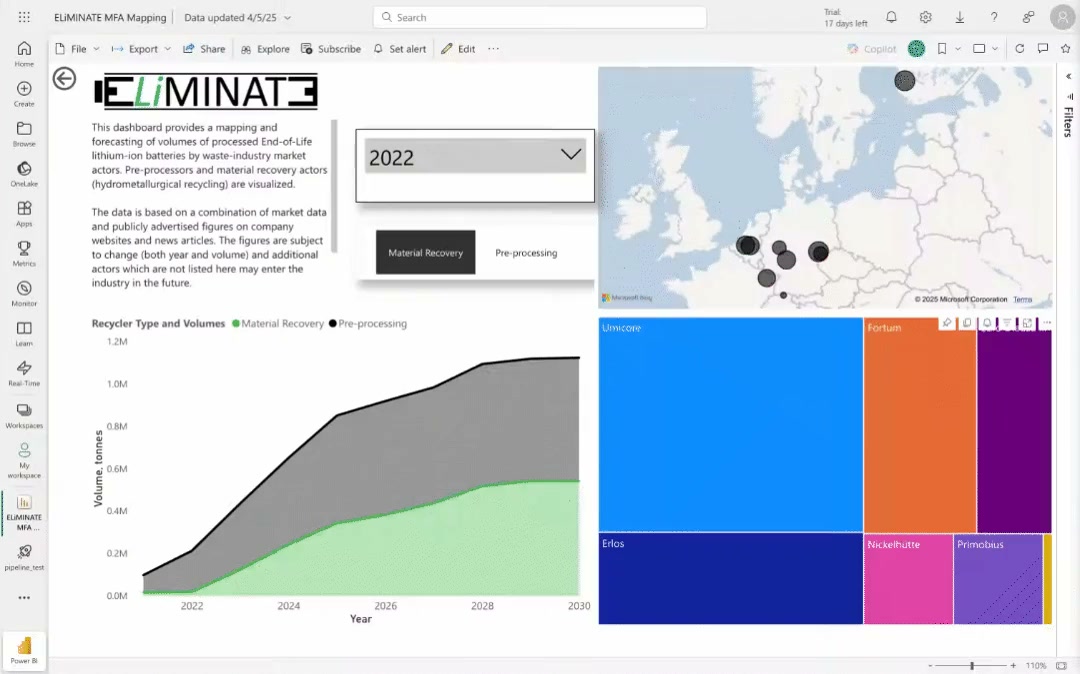
Competitive Analysis: Built Power BI dashboard analyzing competitor capacity evolution (2022-2030) and geographic clustering across Europe.
For readers interested in the technical implementation, the complete optimization formulation is available below:
3. Results and Business Value
Optimal Configuration: For cost, one facility beat every distributed alternative, for all four technologies and both transport-cost scenarios. H₂SO₄ (novel) was the lowest-cost technology, at €1,059M accumulated cost under the low-transport estimate, followed by HCl-NMC, H₂SO₄-NMC, and MSA. The optimal location, however, is not fixed: under low transport costs the two cheapest technologies site in the Nordics, while the more expensive ones site in Central Europe.
Competitive Intelligence: Central Europe shows high recycler concentration (fierce competition, margin pressure), while Northern Europe presents a second cluster with differentiation opportunities. Dashboard enables tracking of competitor capacity expansion and market entry timing analysis.
Regulatory Sensitivity: Transport-cost classification is the dominant variable. Moving from the low to the high transport estimate raised H₂SO₄’s accumulated cost from €1,059M to roughly €1,760M and pulled every technology’s optimal location into Central Europe, showing how hazardous-waste classification rules drive facility placement.
Project Impact: The analysis reduces capital allocation risk for facility developers, reveals geographic opportunities for existing operators, and supports EU regulatory compliance targets by addressing the 98,667 tonne capacity gap with cost-efficient placement.
4. Key Visualizations
The following color scheme is used throughout the network visualizations:
Supply and Demand Network (2030)
Geographic distribution of 98,667 tonnes projected battery recycling demand across Europe, with existing and planned recycler capacity. Under the high-transport estimate Central Europe is the optimal hub, given the concentration of battery production in Germany, France, and Poland; under the low-transport estimate the cheaper technologies pull north into the Nordics.
Material Flow Analysis
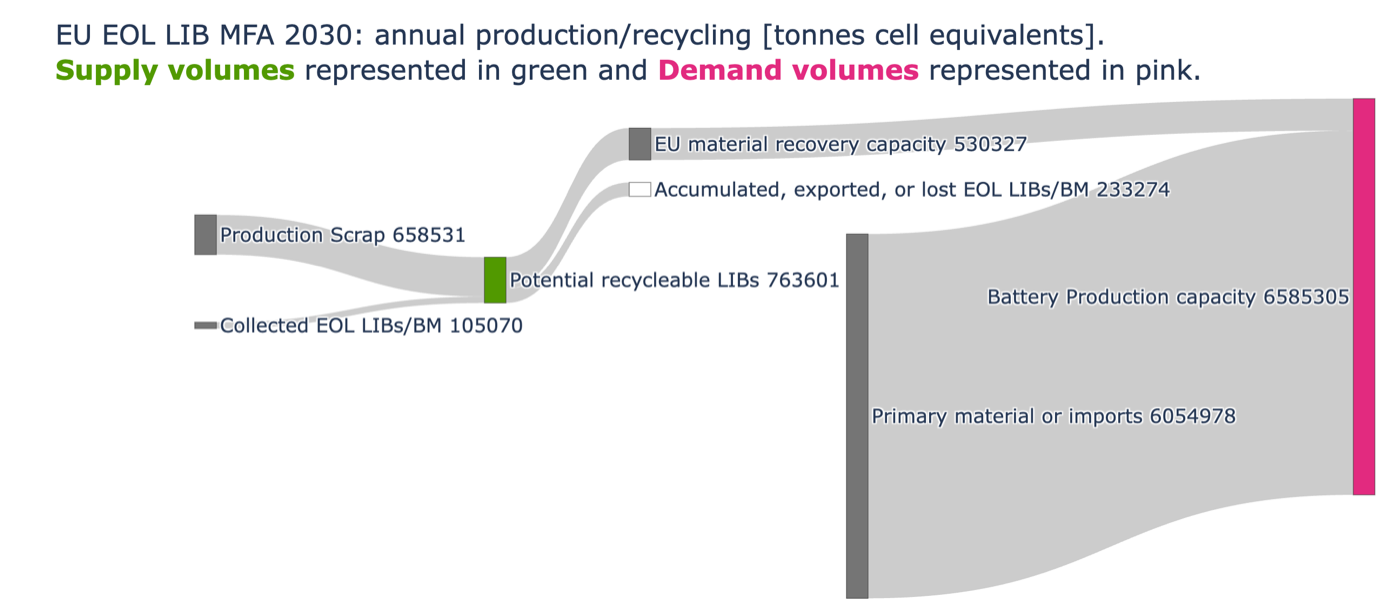
Visual representation of battery material flows through the recycling system, showing how materials move from collection points through processing facilities to final outputs. The Sankey diagram illustrates the scale and efficiency of material recovery pathways.
Cost Analysis Across Technologies
The cost optimization ranked four technologies under two transport-cost scenarios. H₂SO₄ (novel) was lowest in both, at €1,059M accumulated cost under the low-transport estimate and roughly €1,760M under the high-transport estimate. That spread is the cost of regulatory uncertainty on a single technology, not a gap between technologies. The ranking between the four held in both scenarios. The cost-optimal configuration is centralized in every case: one facility maximizes economies of scale.
A parallel CO₂ optimization produced a different network shape. Where cost minimization favors a single facility, emissions minimization favors four (spread across the Nordics and Germany) for three of the four technologies. H₂SO₄-NMC achieved the lowest modeled emissions, at 7,012 tonnes CO₂ under the low-transport estimate, ahead of HCl-NMC, H₂SO₄, and MSA. The two objectives therefore do not share an optimum: the cost-optimal network and the emissions-optimal network are different builds.
Implementation Code
Competitor Intelligence Dashboard
Power BI dashboard tracking competitor capacity evolution (2022-2030) with geographic clustering. Reveals Central Europe’s fierce competition and margin pressure versus Northern Europe’s differentiation opportunities. Interactive features enable company-specific benchmarking and market entry timing analysis.
5. Skills Demonstrated
Optimization & Modeling: Linear programming for multi-criteria decision analysis (cost, emissions, capacity, location) with scenario sensitivity testing
Competitive Intelligence: Market landscape mapping, capacity forecasting, and geographic clustering analysis
Data Engineering: Web scraping, data integration from multiple sources, geospatial analysis across 27 countries
Business Communication: Power BI dashboards and Plotly visualizations translating technical analysis into executive decision-support tools
Relevant to supply chain network design, facility location planning, logistics route optimization, and sustainability strategy roles across manufacturing, cleantech, and consulting sectors.